LearnBaritone
Ukulele basics for beginners
Get to know your Baritone ukulele, how to hold and tune it, and how to make your first sound.
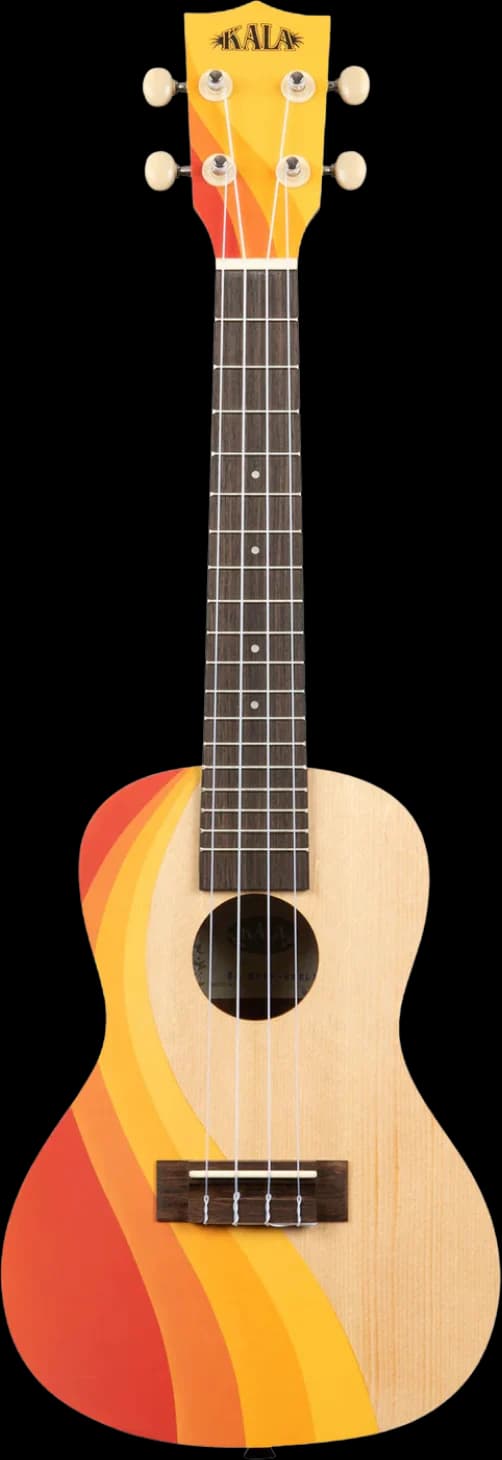
Parts of a ukulele
Learn the names you will see in tuning, chord, and strumming guides.
- Headstock and tuning pegs
- The headstock is the top of the instrument. Turn its tuning pegs to raise or lower each string's pitch.
- Nut
- The small ridge between the headstock and fretboard keeps the strings evenly spaced.
- Neck and fretboard
- The neck supports the fretboard, where your fretting hand presses the strings.
- Frets
- The metal wires divide the fretboard into notes. Press in the space just behind a wire, toward the body.
- Body and soundhole
- The body shapes and amplifies the ukulele's tone. The soundhole helps project that sound.
- Bridge and strings
- The bridge anchors the strings to the body. The strings run from the bridge to the tuning pegs.
Ukulele sizes and tunings
Soprano, concert, and tenor are the most common choices and usually use standard high-G tuning. Baritone ukuleles are larger and use a different tuning.
- Soprano
- The smallest common size, with the shortest scale and closest fret spacing. Usually tuned to standard high-G gCEA.
- Concert
- A little larger than a soprano, with more room between the frets. Usually tuned to standard high-G gCEA.
- Tenor
- A larger body with more room along the fretboard. Usually tuned to gCEA, using either a high-G or low-G string setup.
- Baritone
- The largest common option. Usually tuned to DGBE and played with baritone chord diagrams.
Baritone ukuleles usually use DGBE. Follow Baritone chord diagrams when learning from the guides in this section.
How to tune a ukulele
Start with DGBE unless your instrument specifies another setup.
Ukulele string names and numbers
Hold the ukulele in playing position. String 4 is nearest your face, and string 1 is nearest the floor.
- String 4D
- String 3G
- String 2B
- String 1E
Baritone tuning is D3, G3, B3 and E4. The pitches rise from string 4 to string 1. Unlike Standard high-G tuning, the fourth string is the lowest open note.
Open the ukulele tuner, then pluck and tune D, G, B and E one string at a time. Adjust each tuning peg a little, check again, and recheck all four strings when you finish.
How to hold a ukulele
Support the instrument with your body and strumming arm so your fretting hand stays free to move.
- Sit or stand upright and let your shoulders relax.
- Rest the body against your chest and support it with your strumming forearm.
- Point the neck slightly upward instead of letting it droop.
- Keep your fretting thumb behind the neck so your fingers can move freely.
- Hold the instrument securely without squeezing it.
Make your first sound
Leave every string open. You do not need a chord shape yet.
- Pluck string 4, then 3, 2, and 1 with the pad of your thumb.
- Say D, G, B and E as you hear each string.
- Brush all four open strings once with your thumb. Keep your hand loose and listen for an even sound.
Next, learn how to read ukulele chord diagrams before you make your first chord shape.
Frequently asked questions
- What are the four strings on a Baritone ukulele?
The strings are D, G, B and E from string 4 to string 1. D is nearest your face and E is nearest the floor when you hold the ukulele to play.
- What tuning should a beginner Baritone ukulele use?
Use D3, G3, B3 and E4 unless your instrument specifies another setup. These pitches rise from the fourth string to the first and match the highest four strings of a standard guitar.
- Which hand strums and which hand presses the strings?
In a standard right-handed setup, your left hand presses the strings and your right hand strums. A left-handed setup reverses those jobs and needs the strings arranged for left-handed playing. Use chord diagrams that match your string order.
- Do you need a strap to play ukulele?
No. Your strumming forearm can keep the body against your chest while your fretting hand stays free to move. A strap is optional if the ukulele slips, if you play standing, or if it helps you relax your grip.
Keep playing
Learn how chord diagrams work or tune your ukulele before the next lesson.